What is “The Good Death”
The Good Death Sub Heading
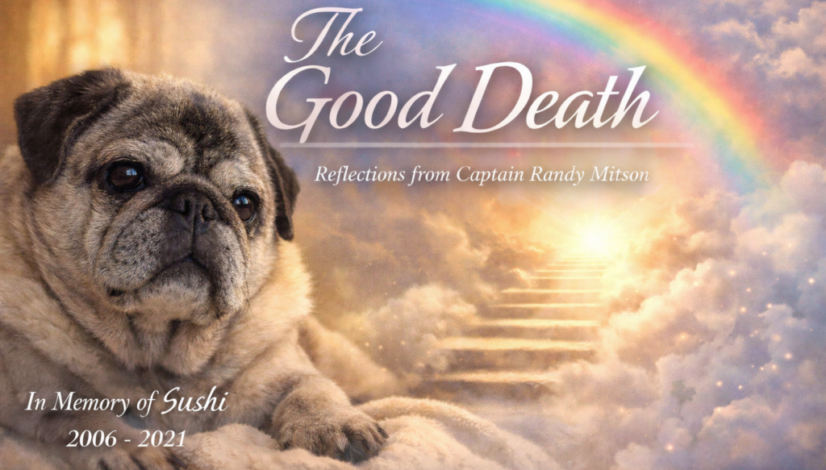
As the Director of STARFLEET Petfleet, and more importantly as Sushi’s (my pug) human for five of her fifteen beautiful years, I read Mel Newton’s essay “The Good Death” through tears.
Two weeks ago, I had to say goodbye to my pug, Sushi.
She was fifteen. She was stubborn, funny, obsessed with her ball, and entirely herself right to the end.
In her article, Mel Newton writes, “A good death, that is our responsibility to the animals under our care, if we can possibly give them one.” That line stopped me. Not because it was new, but because it was true. Painfully true.
When we bring an animal into our lives, we promise them safety. We promise them comfort. We promise them love. What we do not always realise is that one day, love may require letting them go.
Newton reminds us that there is no tidy formula. She says, “Every animal is an individual… and deals with suffering and limitations differently.” Sushi certainly did. She masked discomfort with that classic pug determination. She would still wag her tail. Still look for her ball. Still try to follow me into the next room. It would have been easier if she had clearly “given up.” But she did not.
And that is where Newton’s words pierced me again: “What are you waiting for?”
That question is not cruel. It is compassionate. It asks us to examine whether we are holding on for them or for ourselves.
As pet lovers, especially within STARFLEET Petfleet, we often speak about loyalty, devotion, and unconditional love. But this article reframes love as responsibility. Newton writes that decisions must be grounded in whether there is “a life that can be well-lived on the other side of that suffering.” That phrase echoed in my mind during those final days.
Could Sushi still live well? Or was I asking her to stay because I was not ready?
Fifteen years is a lifetime of morning snorts, backyard zoomies, and the rhythmic sound of paws on ceramic floors. Letting go felt like betrayal. But Newton gently dismantles that fear. A good death is not abandonment. It is protection from prolonged suffering.
As I sat with Sushi in her final moments, I realised something Newton’s piece makes beautifully clear: the last act of guardianship may also be the most loving one. I kept thinking back to the Klingon honourable deaths I had witnessed in several episodes.
For those in our Petfleet family who are walking this path, or who will one day face it, I offer this reflection. Grief does not mean you chose wrong. It means you loved deeply. Choosing peace for your companion does not erase the bond. It honours it.
Sushi is whole. She is happy. She is exactly herself.
And if I had one final duty as her captain, it was to make sure her last chapter was gentle.
Newton’s essay gave language to something many of us struggle to articulate. It reminds us that compassion is not just in how we care for our pets in life, but in how we shepherd them through its end.
For that, I am grateful.